In Japan, it is a traditional custom that people visit Shinto shrines and receive sacred goods such as Ofuda and Omamori. These sacred Shinto Items are called Juyohin. They can give yearly protection, good luck, happiness, or success in business.
Please Note: Getting any Juyohin from online shops or third-party sellers are not connected to Kami-sama and therefore have no effect and are seen as disrespectful to Kami-sama. In that sense, they are essentially just “inactive” decorative merchandise.
Only items received from an actual Shinto shrine are blessed and receive a connection to Kami-sama, which is what gives them their intended effect. If you are unable to visit a Shinto shrine in person, it is perfectly fine to ask a friend to obtain one for you or to ask the shrine directly. However, it should always come directly from a Shinto shrine.
Our shrine offers international shipping, so you can receive our Juyohin anywhere in the world.
After one year of use, it is customary to replace them with new items and return the old ones for Otakiage, the Bonfire Ritual.
Ema – Engimono – Goshuin – Goshuinchō – Hamaya – Hamayumi – Kamidana – Kumade – Ofuda – Omamori – Omikuji
The word Ema literally translates to ‘picture horse’. In ancient Japan, horses were believed to be the “vehicle of the deities” 神様の乗り物, carrying prayers to the Kami-sama.
During the Nara period (710–794 CE), people would donate live horses to Shinto shrines to ensure their prayers reached the Kami-sama. However, since horses were expensive, those who couldn’t afford them began offering wooden, clay, or paper horse figurines instead. Over time, this tradition evolved into the creation of wooden plaques featuring images of horses.
By the Muromachi period (1333–1568 CE), Shinto shrines expanded these designs to include other symbols, such as foxes, which were especially popular at Inari shrines. During the Edo period (1603–1868 CE), it finally became common for individuals to purchase small plaques to communicate their wishes to the Kami-sama more conveniently.
Today, Ema come in a variety of designs and forms, often reflecting the shrine’s Kami-sama or the zodiac sign of the year.
You can receive an Ema by making a donation to a Shinto shrine. While they are traditionally obtained during shrine visits, we offer international shipping to accommodate our global shrine community.
Our Ema are beautifully illustrated and specially blessed to help make your wishes come true. The back of each Ema is branded with our shrine’s insignia!
Once you have your Ema, write your wish on the back. It can be anything from a personal goal to a heartfelt hope for someone else. If you’re visiting a Shinto shrine, it’s customary to hang it on the shrine grounds. If you’re keeping it at home, you can place it high on the north or west wall.
When wishes are granted, it is customary to visit a Jinja (Shinto shrine) and express gratitude to the Kami-sama by offering tokens of appreciation, such as money, rice, sake, or vegetables. Even if your wish has not yet been fulfilled, showing gratitude to Kami-sama helps strengthen your resolve and renew your determination.
Ema should be renewed after one year and the old Ema should be sent back to us for the Bonfire Ritual – Otakiage.

Engimono are often received during Hatsumōde (the first shrine visit of the year) to invite good fortune and prosperity for the year ahead. Engimono are typically displayed high on the north or west wall in your home or workplace. It is customary to replace them with new ones after one year to refresh their blessings. You can send your old Engimono back to our shrine for the Bonfire Ritual – Otakiage.
The term “Engimono” derives from the kanji 縁 (en), meaning “fate”, “connection” or “omen,” and 起 (ki/gi), which conveys the idea of “something occurring”.
Our Shrine offers the following Engimono:
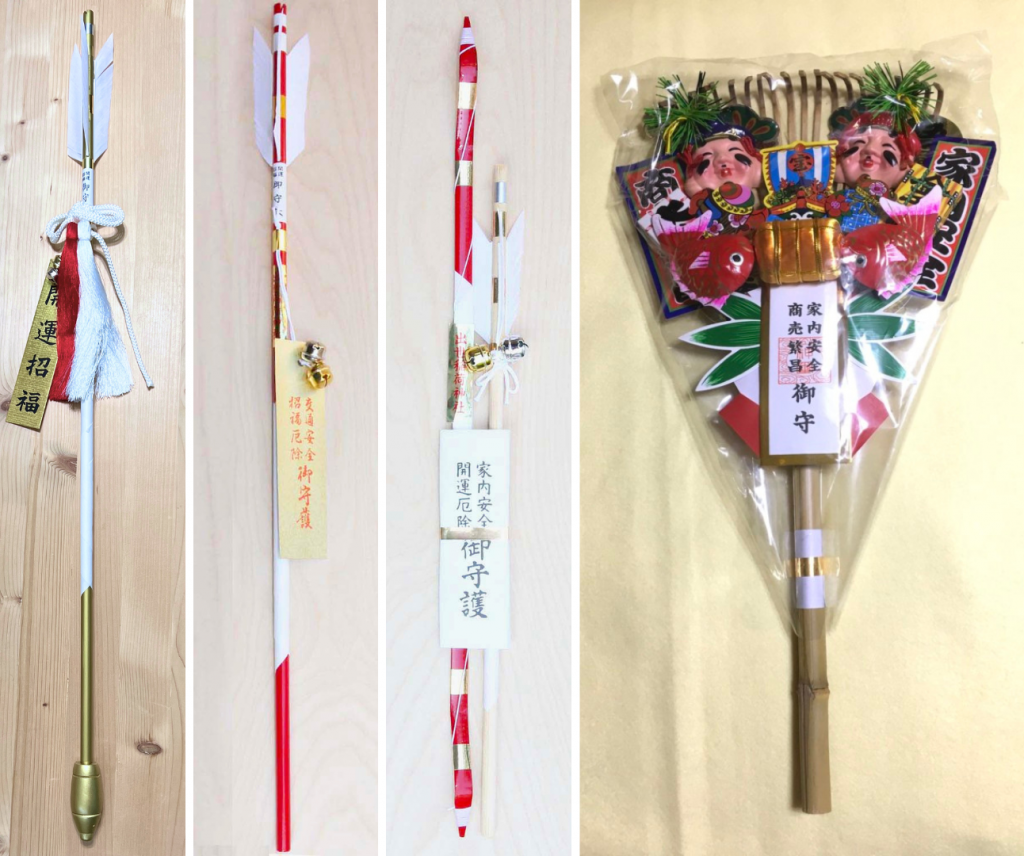
🔸Hamaya 破魔矢: Decorative arrow blessed for warding off evil.
🔸Hamayumi 破魔弓: Decorative bow paired with an arrow blessed for warding off evil.
🔸Kumade 熊手: Bamboo rake symbolizing the “raking in” of happiness, good luck, money, and success in business and career.
Engimono should be renewed after one year and the old Engimono should be sent back to us for the Bonfire Ritual – Otakiage.
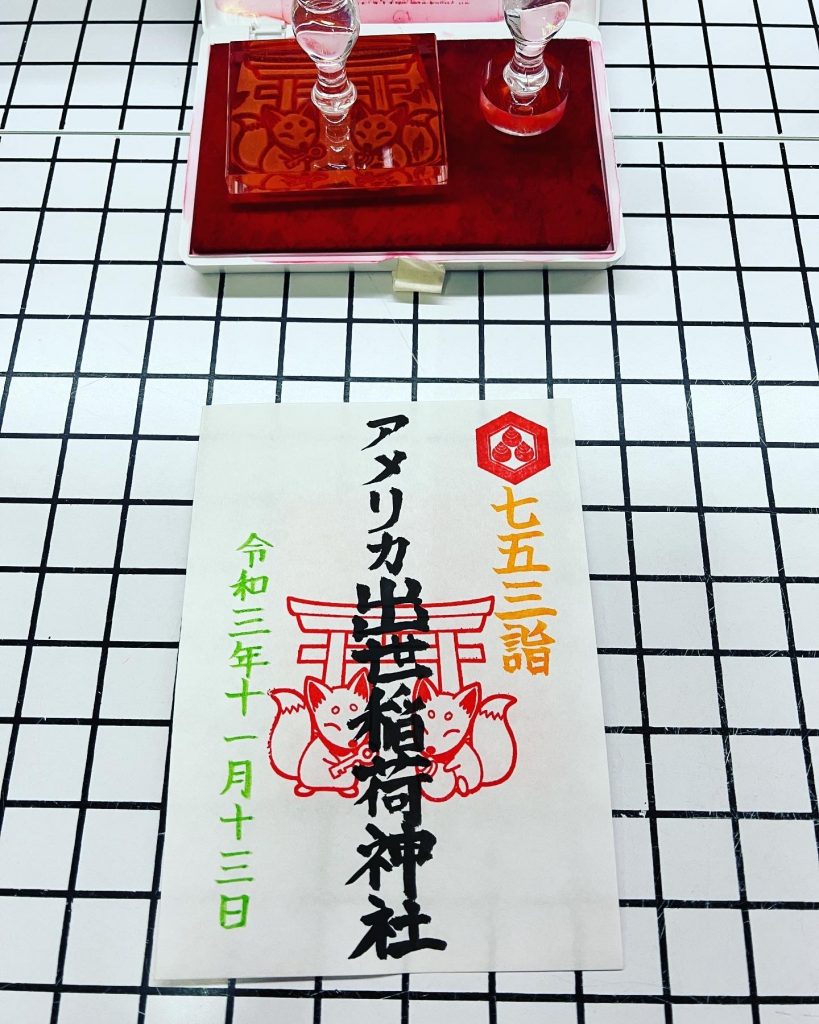
The seals, called Goshuin, are unique stamps with vermilion ink and calligraphy, inscribed by Shinto shrine officials as proof of a visitor’s pilgrimage. In the middle, you will usually find the name of the Shinto shrine. On the left-hand side, you will find the date of your visit, and on the right, for our Goshuin, you will see the occasion for your visit. You can receive our shrine’s Goshuin at our in-person events, such as Oshōgatsu or Aki-matsuri.
You can find more details below, in the section about Goshuinchō.
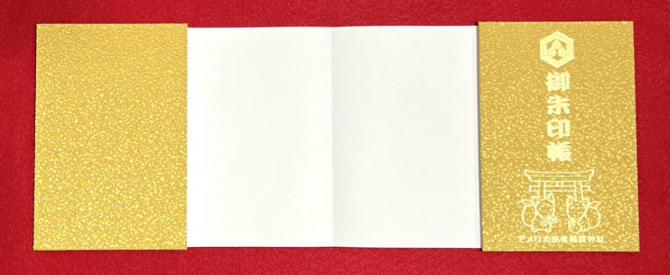
A Goshuinchō, often translated as a “book of seals,” is a traditional Japanese book used to collect seals from Shinto shrines. These seals, called 御朱印 Goshuin, are unique stamps with vermilion ink and calligraphy, inscribed by Shinto shrine officials as proof of a visitor’s pilgrimage.
The practice of collecting these seals dates back centuries and is believed to have originated as a way to prove that a person had copied sutras during devotional practice.
Collecting Goshuin has gained widespread popularity, especially among young people and tourists. Many use their Goshuinchō as a souvenir, filling it with seals from places they’ve visited.
These Goshuinchō and Goshuin are available at the Shamusho, or shrine office, in exchange for a donation. Some Shinto shrines offer additional, special seals to mark the seasons, celebrate festivals, or highlight unique features of the area.
To use a Goshuinchō, simply bring it to the shrine office, where a staff member will inscribe the seal along with the shrine name and date of the visit.
Receive our Shrine’s Goshuin at our in person events, such as Oshōgatsu or Aki-matsuri. Goshuin are only available in person and cannot be received online.
Please note: A Goshuinchō is intended exclusively for official Goshuin stamps received directly from Shinto shrines and should not be used for unrelated stamps, such as train stamps or stickers. It is also recommended to keep separate Goshuinchō when visiting Buddhist temples and Shinto shrines.
Hamaya are decorative arrows blessed to ward off evil and to bring good luck and happiness. Please show respect by not playing with or actually shooting the arrow.
They are part of our Shrine’s Engimono.
Please display Engimono high on the north or west wall, or put them on a shelf in your living room or workplace.
Hamaya should be renewed after one year and the old Hamaya should be sent back to us for the Bonfire Ritual – Otakiage.
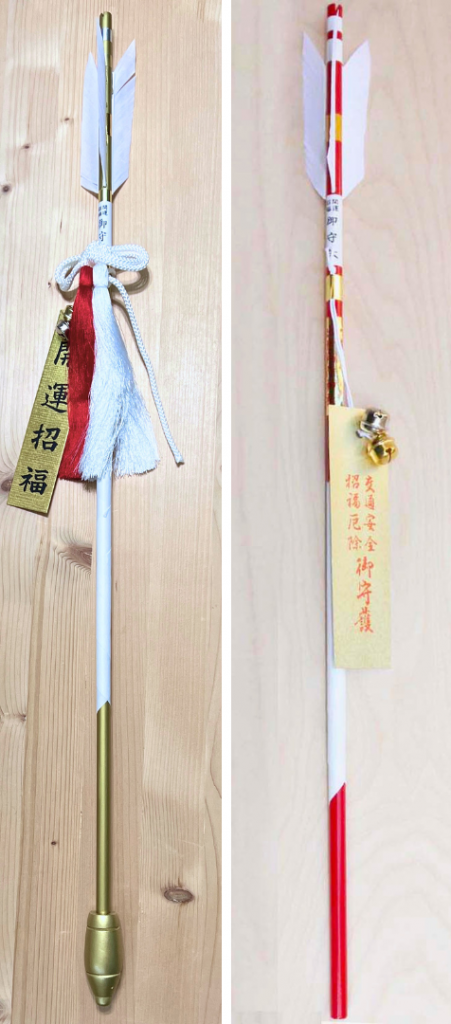
Hamayumi are decorative bows paired with an arrow blessed to ward off evil and to bring good luck and happiness. Please show respect by not playing with or actually shooting the arrow.
They are part of our Shrine’s Engimono.
Please display Engimono high on the north or west wall, or put them on a shelf in your living room or workplace.
Hamayumi should be renewed after one year and the old Hamayumi should be sent back to us for the Bonfire Ritual – Otakiage.
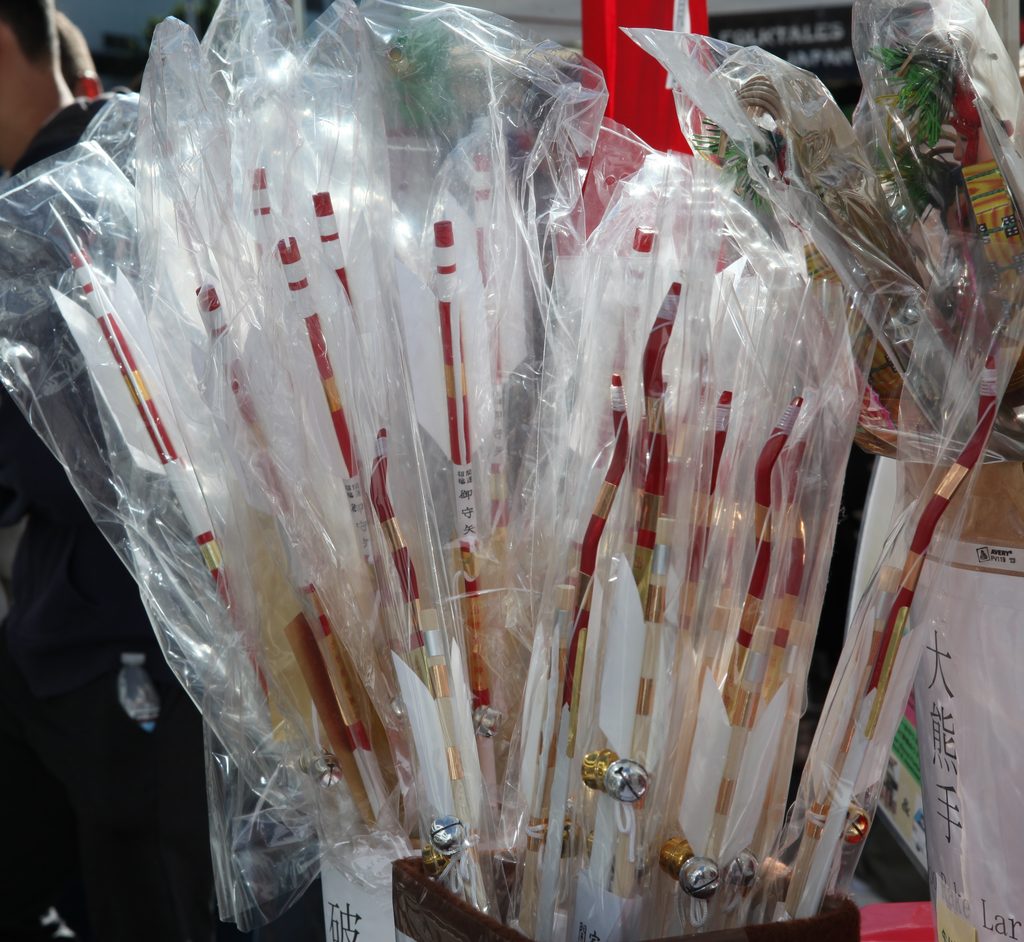
The Kamidana, or “deity/spirit-shelf”, is a miniature household Shinto shrine designed to enshrine a Kami-sama. It allows individuals to engage in Shinto practices and invite blessings of safety, prosperity, and good fortune into their daily lives.
It is important to treat the Kamidana with respect, as it is not a mere decorative item but a sacred object.
Kamidana from our shrine are built to order and they are blessed and purified before shipping. We recommend holding the Kamidana installation ceremony when you set up your Kamidana, to invite safety, success, and good fortune.
Our Shrine offers different Gokitō blessing ceremonies for Kamidana Installation at your home, your business, or your Dōjō.
Kamidana Installation Ceremony for your Home (Safety, Success & Purification Blessing)
Kamidana Installation Ceremony for a Business (Safety, Success & Purification Blessing)
Kamidana Installation Ceremony for a Dōjō (Safety, Success & Purification Blessing)
A traditional Kamidana typically includes the following elements:
⛩️ Miyagata 宮形 – A small shrine structure that serves as the central feature of the Kamidana.
⛩️ Ofuda 神札 – A talisman placed within the Miyagata, connected to the enshrined Kami-sama.
⛩️ Shinkyō 神鏡 – A sacred mirror placed in front of the Miyagata doors.
⛩️ Shinsen 神饌 – Daily offerings such as rice, water and salt, presented using Shinki, white porcelain vessels. Sake is offered on the 1st and 15th of each month.
⛩️ Sakaki Branches 榊 – Sacred evergreen branches.
✨ Other decorative elements may include Tōrō lanterns, a Torii gate, Yatte-san (Kitsune statues), or Nobori banners. Items like plushies or crystals are NOT traditional and should not be placed on the Kamidana.
The Kamidana should be placed in a high position, on a shelf along the north or west wall of your living room or workplace. Ensure the area around the Kamidana is clean. Avoid placing the Kamidana below eye level, in bedrooms, directly above doorways, in kitchens, on front or back porches, or on patios.
The Mitobira (doors of the Miyagata) usually stay closed, except during rare and significant occasions such as New Year’s, Ofuda replacement, cleaning, or major celebrations.
Before presenting and removing offerings and/or offering prayers, it is customary to perform Temizu, a purification practice that involves cleansing your hands and mouth.
⛔ Please keep in mind that offerings should never be left out for multiple days, weeks, or months. Doing so is considered highly disrespectful to Kami-sama and can also pose a serious health risk! Even if you are unable to make daily offerings, it is important to remove the offerings at the end of the day.
For information on Kamidana care, offerings, and more, visit our Q&A!
More detailed guidance is available when you join our Shrine Membership and receive our Membership Handbook.
Kamidana and their items do not need to be replaced every year. However, if you wish to part with your old Kamidana or any of its items, we are happy to accept them for purification, followed by recycling or Otakiage.
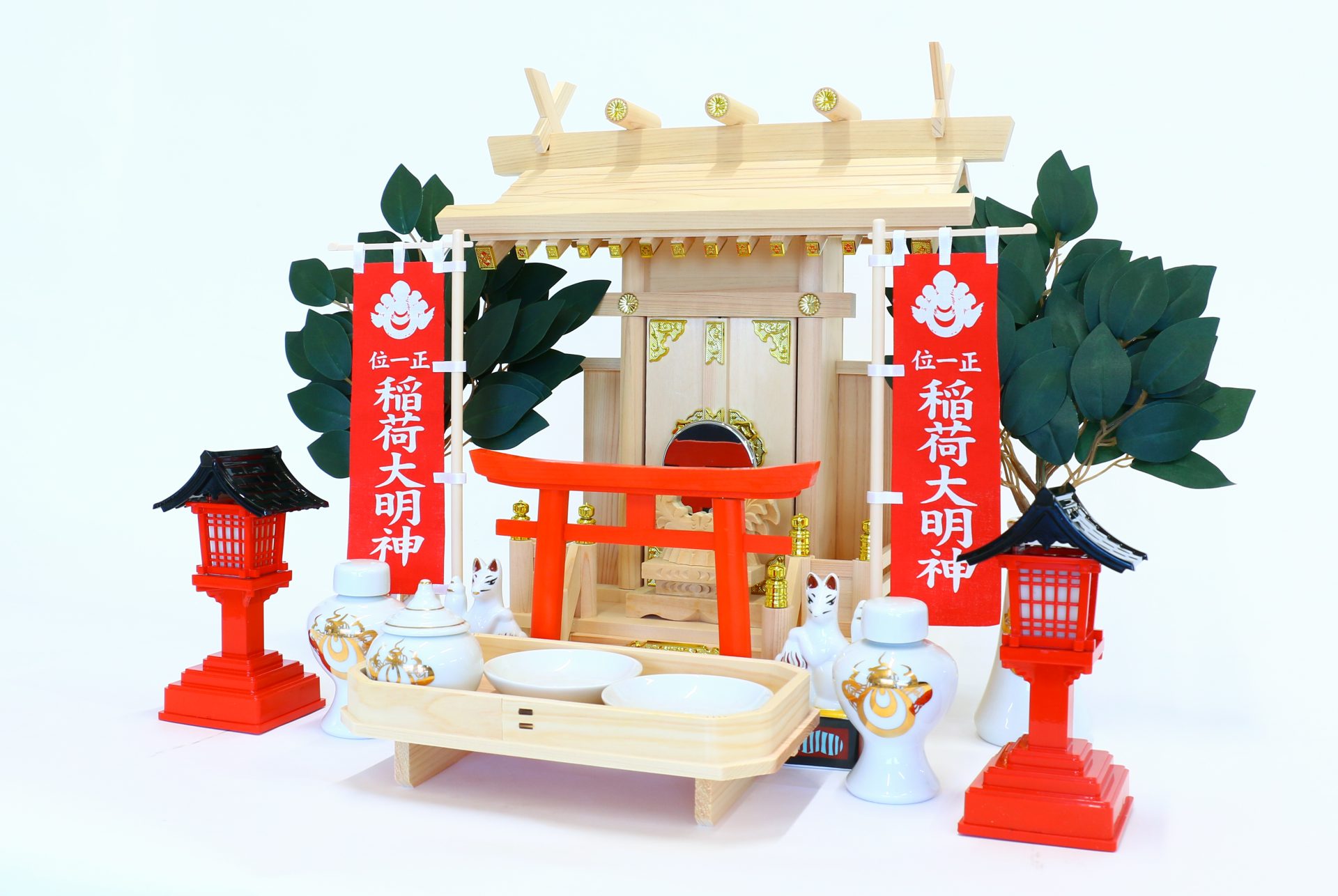
Kumade are Bamboo rakes symbolizing the “raking in” of happiness, good luck, money, business and career success. They are part of our Shrine’s Engimono.
Please display Engimono high on the north or west wall, or put them on a shelf in your living room or workplace.
Kumade should be renewed after one year and the old Kumade should be sent back to us for the Bonfire Ritual – Otakiage.

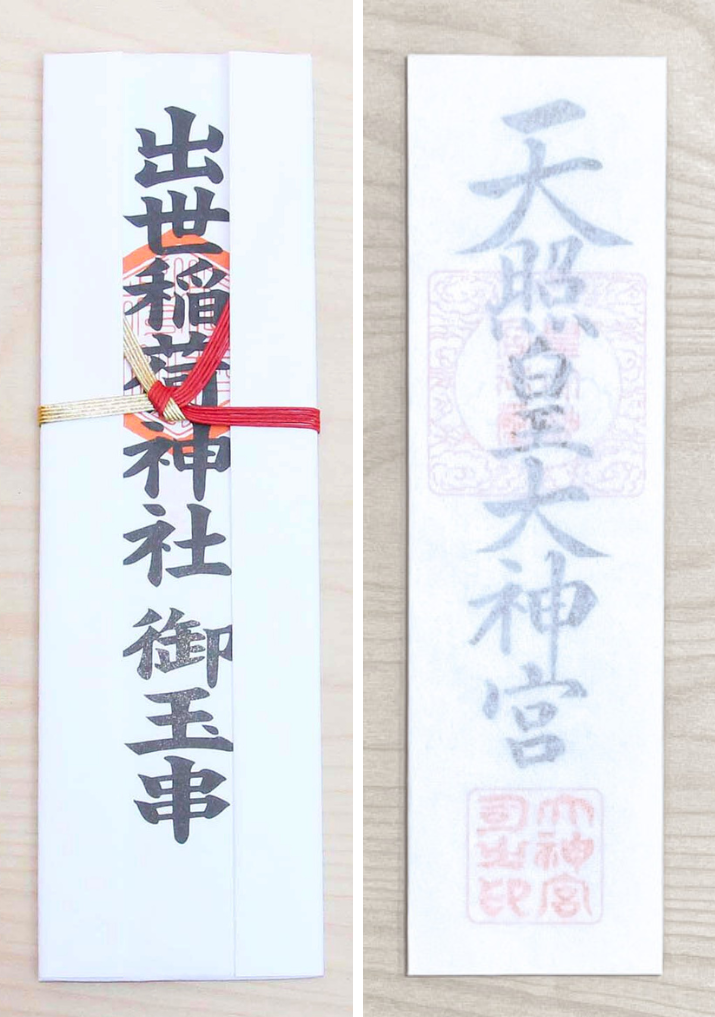
An Ofuda is a sacred talisman inherently connected to the Kami-sama. It is often made of rice paper and/or 檜 Hinoki wood (Japanese Cypress). Depending on the Kami-sama connected to the Ofuda they can bring different blessings, such as good fortune, happiness, safety, success in business, or good health.
The wood and paper Ofuda available at our shrine are connected to all of our enshrined Kami-sama, with the exception of the Jingu Taima Ofuda, which is specifically dedicated to Amaterasu Ōmikami.
宇迦之御魂神 Uka-no-Mitama-no-Kami, the deity of success, productivity, business, food, and harvests
誉田別命 Homudawake-no-Mikoto, the deity of literary and military arts, to whom samurai paid respect
大床主神 Ōtokonushi-no-kami, for recovery from illness
武甕槌神 Takemikaduchi-no-kami and 経津主神 Futsunushi-no-kami, for martial arts and victory
水波女神 Mizuhame-no-kami, for safe transportation by water
須佐之男命 Susanoo-no-mikoto, 大物主神 Ōmononushi-no-kami, 大床主神 Ōtokonushi-no-kami, 菅原道真公 Sugawara Michizane, and 事代主神 Kotoshironushi-no-kami
An Ofuda should be treated with respect and care! To properly care for an Ofuda, it is recommended to place it in a Kamidana (a small household Shinto shrine) or Ofuda-tate (Ofuda stand), high on the north or west wall in your home or workplace. If there is an occupied floor above, it is recommended to write the kanji for cloud 雲 and place it on the ceiling above the Ofuda.
Ofuda are not to be used as decorations but as objects of spiritual protection and devotion.
Traditionally, offerings of rice, salt, and water are placed each morning and taken down in the evening for consumption. However, if there’s any concern that the offerings might spoil, attract insects, or be disturbed by animals, it’s perfectly acceptable to remove them shortly after they’ve been placed.
An Ofuda is obtained through a donation at a Shinto shrine, not purchased, and it should be replaced with a new one after one year. This is not an exact 365-day “expiration period”, but rather a general timespan during which the connection to Kami-sama gradually fades.
Ofuda should be renewed after one year and the old Ofuda should be sent back to us for the Bonfire Ritual – Otakiage.
Our Q&A includes a step-by-step guide on how to replace your Ofuda.
Important note: Do not remove or tear off the outer elements wrapped around the Ofuda. The Mizuhiki 水引 (decorative cord) and Hakama 袴 (paper) are part of the Ofuda itself. Removing them is highly disrespectful to Kami-sama.
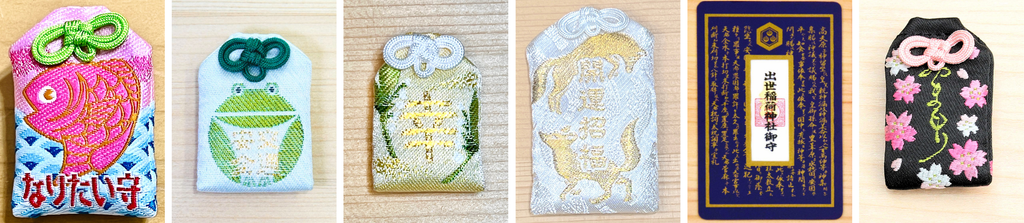
Omamori comes from the Japanese word mamoru 守る, meaning to protect.
Omamori are small pouches woven from silk thread. They are intended to bring blessings such as safety, success, health, or happiness. Modern versions include stickers, cards, or creative shapes unique to certain Shinto shrines.
An Omamori should be treated with respect and care, as it is connected to the Kami-sama.
To use an Omamori, keep it close to you. You can carry it inside a bag or purse, or place it in a vehicle for safe travel. Avoid attaching it to the outside of bags, as it may touch the ground and collect dirt, which would be considered disrespectful to the Kami-sama.
It’s also important not to open the pouch. It is said that opening it will cause it to lose its good fortune and it is also disrespectful to the Kami-sama. Replace Omamori yearly, when they get lost, damaged, broken or after they fulfill their purpose and return the old one to our shrine for the Bonfire Ritual – Otakiage.
Omamori can be thoughtful gifts for loved ones and are a meaningful way to support Shinto shrines. Gifting an Omamori is said to triple its effect.
Omamori should be renewed after one year and the old Omamori should be sent back to us for the Bonfire Ritual – Otakiage.
Please note: Some Omamori are only available upon request of the corresponding Gokitō Ceremony.
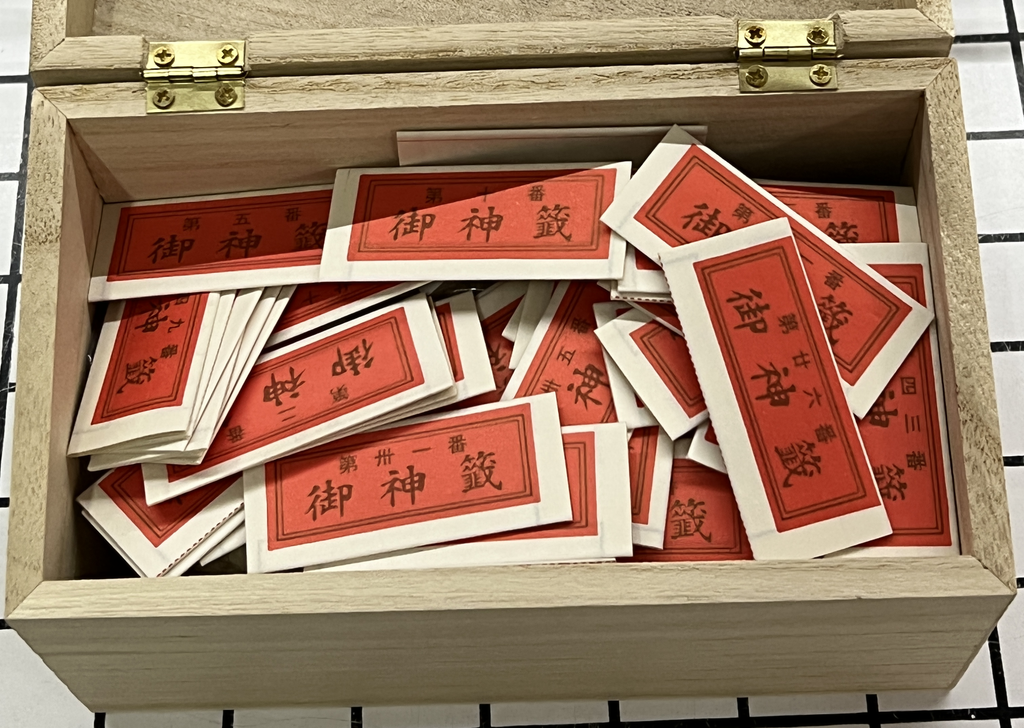
Omikuji, meaning “sacred lot,” is a traditional form of Japanese fortune-telling found at Shinto shrines. To receive an Omikuji, visitors typically make a small offering and draw a lot from a box.
The result, written on a slip of paper, is believed to reflect the will of the Kami-sama and provides predictions about various aspects of life, including health, love, success, and personal aspirations.
The fortunes are categorized into different levels of luck:
Great luck 大吉 daikichi
Moderate luck 中吉 chūkichi
Good luck 吉 kichi
Small luck 小吉 shōkichi
Future luck 末吉 suekichi
Bad luck 凶 kyō
Great misfortune 大凶 daikyō
If the fortune is bad, it is customary to fold the paper and tie it to a pine tree or onto designated wires or metal poles at the shrine. This practice is rooted in a pun on “pine” (松, matsu) and “to wait” (待つ, matsu), symbolizing that the misfortune will remain behind rather than follow the bearer. If the fortune is good, you can choose to keep it for luck or tie it at the shrine to amplify its blessings.
Stay updated on our upcoming in-person events through our social media channels.
🔸 Bluesky (@shintoinari.bsky.social)