On this page, you can find instructions on how to follow the basic prayer, Temizu, Tamagushi Hairei, and ceremony etiquette.
To show respect and gratitude towards Kami-sama, you can follow these simple steps:
Bow deeply twice, Clap twice, Bow deeply once more.
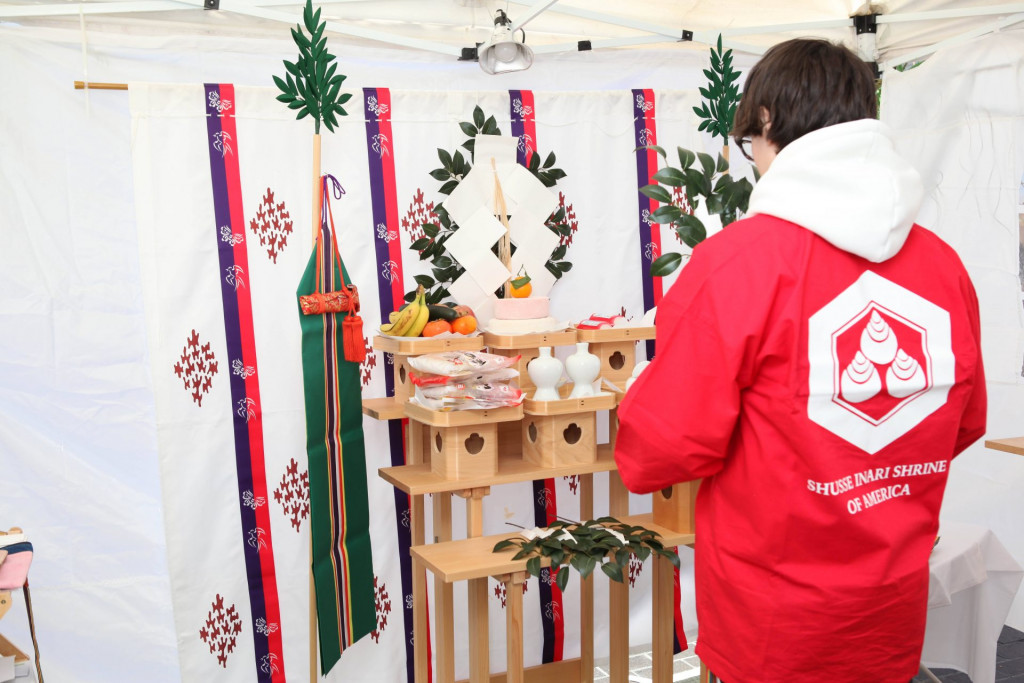
Bows should be a deep bow of 90 degrees, palms covering the knee caps. Put your hands together, at chest level, and clap twice. Slide the right hand back slightly before clapping. Keep your hands together at chest level while expressing your gratitude and appreciation to Kami-sama. Perform another deep bow.
If you do not have a Kamidana or Ofuda at home, you can just do this Basic Prayer in nature or at home facing towards nature or a window to the outside.
Before interacting with Kami-sama, we cleanse ourselves to remove the Kegare (spiritual impurity). Make sure you have a clean handkerchief, towel, or something similar ready to wipe your hands.
Perform Temizu in the following order:
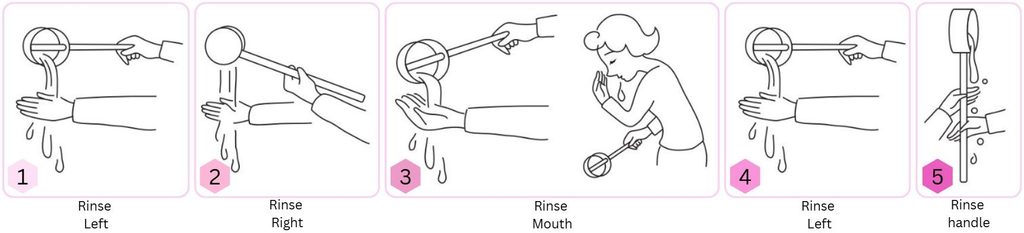
Step 1: Pick up the Hishaku (ladle), fill it with water and rinse your left hand.
Step 2: Rinse your right hand.
Step 3: Pour water into your left hand and rinse your mouth. Let the water fall out of your mouth into the drain area.
Step 4: Rinse your left hand again.
Step 5: Tip the Hishaku (ladle) upright to rinse the handle and put it back in its place.
Please use the kitchen sink, or another sink that is not located in a room with a toilet.
Perform Temizu in the following order:
Step 1: Turn on the water in your sink and rinse your left hand.
Step 2: Rinse your right hand.
Step 3: Cup some water in your left hand and use it to rinse your mouth. Let the water out of your mouth into the sink, while covering your mouth.
Step 4: Rinse your left hand again.
Step 5: Dry your hands with a clean towel and turn off the sink.

When visiting a Shinto shrine, you may have the opportunity to perform Tamagushi Hairei, the act of offering Tamagushi to the enshrined Kami-sama. This is a deeply meaningful way to connect with Kami-sama and express your respect and gratitude.
Shinto Inari Kai’s VIP members attending our ceremonies may offer Tamagushi to Kami-sama.

Step 1: Receive the Tamagushi from the Shinto priest or shrine staff. Stand and make a small bow. Hold the Tamagushi at chest level, with your left palm facing up and your right palm facing down.
Step 2: Walk to the an (table), stop one step before the an and make a 45 degree bow. Turn the Tamagushi 90 degrees clockwise.
Step 3: Bring both hands together around the stem and silently say your message to Kami-sama.
Step 4: Move your right hand under the leafy end.
Step 5: Turn the Tamagushi another 180 degrees clockwise.
Step 6: Take one step forward and place the Tamagushi on the an with both hands. The stem should face towards Kami-sama.
Step 7: Perform two deep bows, two claps, and one deep bow. Refer to the Basic Prayer Instructions above.
Step 8: Take one step back and make a 45 degree bow. Return to your seat without walking along the seichū (center line).
Before attending a ceremony, please:
Norito are prayers recited during ceremonies or at home. They are written in Yamatokotoba, an ancient form of the Japanese language. They contain Kotodama, the vibration of the words having the power of spirits, so the phrasing and sound of the Norito are important. Kotodama affects not only yourself but also the air around you. This is the reason they are spoken in Japanese and not, for example, in English.
One of the most known Norito is the Ōharae no Kotoba 大祓詞 (Great Purification Prayer). We read it aloud during our monthly Tsukinami-sai ceremony. You can find it in our Member Handbook or the Ōharae no Kotoba Handbook.